
RECET Podcast: Actors of Yugoslav Socialist Internationalism

What do the life trajectories of Yugoslav experts abroad and students from the Global South in Yugoslavia tell us about Yugoslav connections with the postcolonial world? In this episode, I zoomed in on the actors of Yugoslav socialist internationalism with Peter Wright. Discussing the positionalities of experts, political activism of students and questions of racism and anti-racism, Wright argues that the experts and students help us see Yugoslavia’s relationship with the postcolonial world a little bit differently than how it is usually represented.

Peter Wright is an assistant professor in the Department of Slavic Languages and Literatures at the University of Illinois, Urbana Champaign. His work revolves around Yugoslavia‘s relations with the Global South during the Cold War, focusing on development aid, education, and racism and racialisation.

The Transformative Podcast takes the year 1989 as a starting point to think about social, economic, and cultural transformations on a European and global scale. This podcast is produced by the Research Center for the History of Transformations (RECET).
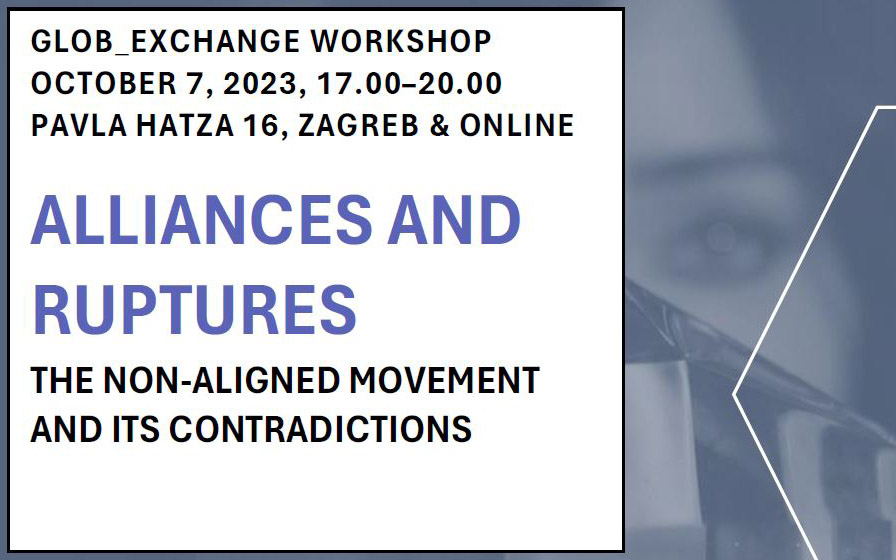

Workshop “Alliances and ruptures. The Non-aligned movement and its contradictions”

Histories of the Non-Aligned Movement keep opening up a variety of unexplored topics, as well as new perspectives on its organisation and the promotion of transnational networks of solidarity. In doing so, these new perspectives help in formulating critical questions about the legacies of this political platform, and encouraging new forms of responsibility in terms of for whom, how and why histories of non-alignment are being narrated.

Defined by a vast global network and diverse epistemic regimes, this field of research is inseparable from ongoing discussions on the decolonisation of knowledge production and demands the diversification of agents, as well as new ways of creating and narrating. The narratives that emerge from these discussions shed light on less known contradictions, providing new insights and addressing important methodological challenges.

This workshop gathers researchers from different backgrounds: historians, architectural historians/curators and artists, with the aim of critically reassessing the complexities of the Non-Aligned Movement through several case studies. While diverse in their geographies and approaches, participants’ presentations will revolve around the common questions of how these histories came to be, and how can they be explored and narrated in ways that are meaningful in the present.

Presentations by Jelena Đureinović, Vladimir Kulić, Behzad Khosravi Noori and Magnus Bärtås will be followed by a panel discussion of the participants, moderated by Sanja Horvatinčić and Paul Stubbs.


The workshop is part of the program of the final conference of the HRZZ project Models and practices of global and cultural exchange and the movement of non-aligned countries: research into spatio-temporal cultural dynamics.